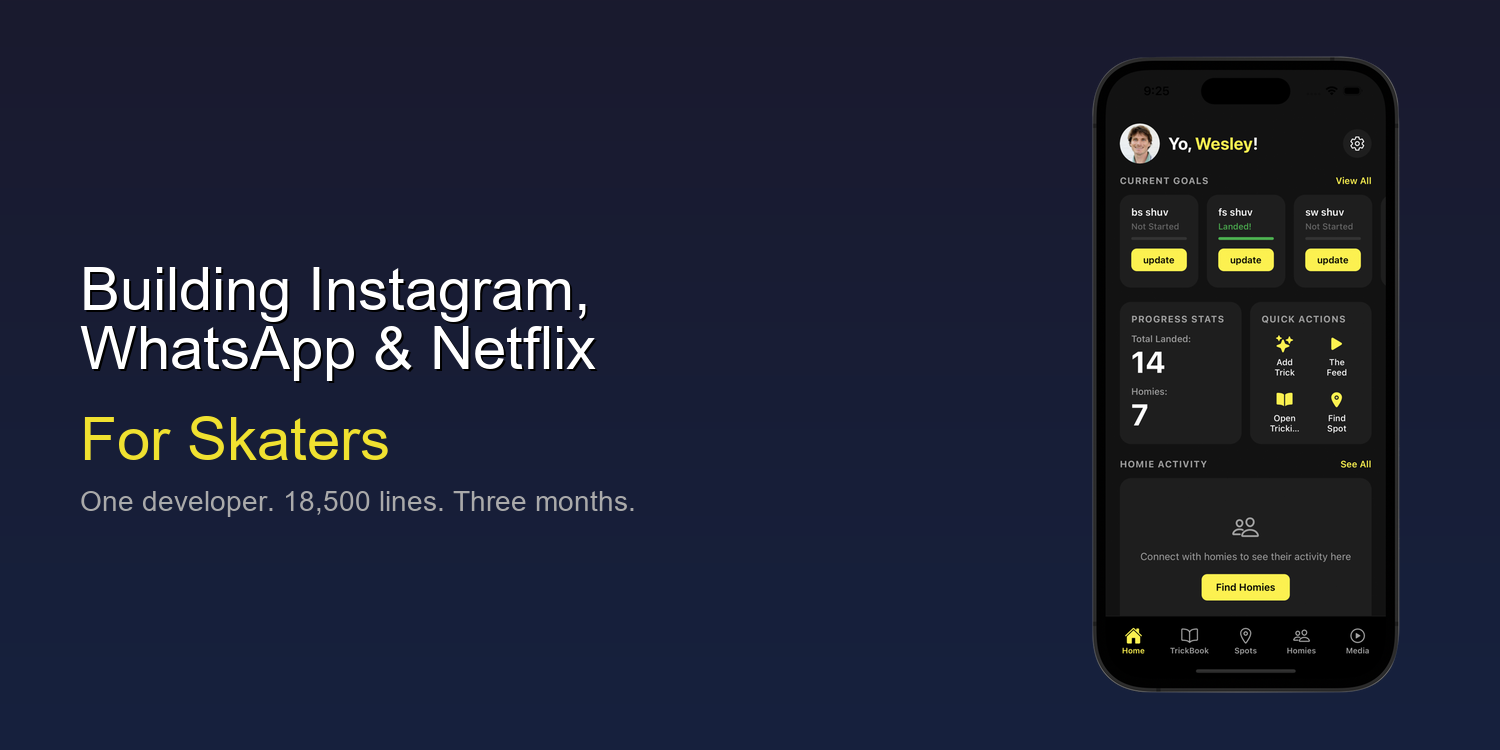
The dirty secret of 2026
Here's something the tech industry doesn't want you to know: the moat is gone.
Building a social feed? That used to require a team of engineers, a $10M seed round, and 18 months of runway. Building real-time messaging? Add another $5M and a dedicated infrastructure team. Video streaming with adaptive bitrate? Better raise a Series A.
Not anymore.
I'm one guy with a coding agent, and I just shipped all three. For skateboarders.
What I Actually Built
TrickBook started as a simple idea: let skaters track which tricks they've landed. A checkbox app. Version 1.0.
Then I kept going.
The Feed — An Instagram-style social feed where riders share clips, react with 🤙 and ❤️, and discover new skaters. The algorithm prioritizes your "homies" (friends) and weighs engagement, recency, and completion rate. No ads. No shadowbanning. Just clips.
DMs — WhatsApp-caliber messaging. Real-time delivery with WebSockets. Read receipts. Conversation threads. Plan sessions, share spots, talk shit about that kid who claims he landed a tre flip.
The Couch — A Netflix-style video library for classic skate videos. HLS streaming, adaptive bitrate, collections, reactions. We're uploading the films that defined skating — Yeah Right!, Sorry, This Is Skateboarding — and making them accessible in one place.
Spots Map — Pin your local spots. Share them with your crew or keep them secret. Think Google Maps, but for ledges and rails.
Trickipedia — An encyclopedia of every trick, organized by category and difficulty. See the progression. Track what you've landed. Know what's next.
All of it. 18,500 lines of code. Three codebases. One developer.
The Tech Stack (For the Nerds)
- Backend: Node.js + Express, MongoDB Atlas, 25 API route files
- Web App: Next.js + React, deployed on AWS Amplify
- Mobile App: React Native (Expo), live on the iOS App Store
- Video Streaming: Bunny.net CDN with HLS adaptive streaming
- Real-time: Socket.io for DMs and live comments
- Payments: Stripe with freemium tiers
- Auth: JWT + Google SSO
- Maps: Google Places API
The backend alone is 7,200+ lines. The web frontend is 9,100+ lines. The mobile app is 2,100+ lines.
A year ago, this would have taken a team. Today, it took me and Claude.
How Coding Agents Changed Everything
Here's the workflow:
- I describe what I want in plain English
- The agent writes the code
- I review, test, iterate
- Ship
That's it. That's the whole process.
When I needed real-time messaging, I didn't spend three days reading Socket.io docs. I told the agent: "Add WebSocket support for direct messages. Emit events on new messages and read receipts. Store conversations in MongoDB."
Fifteen minutes later, it worked.
When I needed video streaming, I didn't research CDN providers for a week. I told the agent: "Integrate Bunny.net Stream. Upload videos, generate HLS URLs, create signed tokens for playback."
Done by lunch.
I'm not saying it's easy. You still need to understand architecture. You still need to make product decisions. You still need to know when the agent is wrong (and it will be wrong).
But the grunt work? The boilerplate? The "how do I parse this response" and "what's the right middleware pattern"?
Gone. Automated. Handled.
Why Action Sports?
Because we've been posting clips on platforms that don't care about us.
Instagram's algorithm buries your content unless you pay. TikTok is a slot machine designed to hijack your dopamine. YouTube shorts is... fine, I guess.
But none of them are for us. They're for advertisers. We're the product.
TrickBook is different. By riders, for riders.
No ads. No algorithmic manipulation. No corporate shareholders demanding "engagement metrics."
Just a community of people who love riding, building tools for each other.
The Real Point
This isn't really about TrickBook. It's about what's now possible.
If I can build Instagram + WhatsApp + Netflix for action sports, what can you build?
- A Strava for rock climbers?
- A Letterboxd for anime?
- A Goodreads that doesn't suck?
The gatekeepers are gone. The tools are democratized. The only question is: what do you care enough to build?
Want to Build Like This?
I'm documenting my entire process — the prompts, the architecture decisions, the mistakes, the wins.
Because if one person can build a social platform, imagine what the rest of us can do.
Wes Huber is a full-stack developer and the creator of The TrickBook. He's been skating since he was 14 and coding since he was 19. He still can't land a kickflip consistently.
#ByRidersForRiders